

The Fall of a Giant
Before writing this article I had not logged into my watch collecting Instagram account for over a year. I am not alone in dropping out of the social media side of the watch collecting hobby. Several friends who continue with watch-related group texts, deleted Instagram from their lives over a year ago. Now, when I look at my feed, I see two or three of the old posters and that’s all. Maybe the algorithm is just hiding them from me or maybe, like my friends, they left for better mental health.
One cannot deny that Instagram was the premier instrument of the covid-era explosion in watch collecting. Collector groups coallesced around hashtags such as #SpeedyTuesday, #WatchFam, #GrandSeikoWednesday and the double entendre of #watchporn. Thousands of wristshots were posted daily with the requisite long tail of hashtags in an attempt to harvest as many likes and comments as possible. For a while it seemed innocent, fraternal and a welcome distraction to the unprecedented world situation unfolding beyond the watch box.

However, Instagram continued to fill our watch feeds with more ads and irrelevant content. Am I the only watch collector that Instagram thinks is interested in large objects being destroyed by an industrial double-toothed roller crusher? I finally stopped logging in when I saw watch content posts fall below 1 in 5 on my feed. The often beautiful watch images from collectors I followed were constantly interspersed by ads for scams, health supplements, king-rescuing games, chef-promoted non-stick pans, and a thousand other things I don’t want. In all that time, did I ever see an ad on my feed for a watch retailer you ask? No, I did not.
An App for Watch Collectors
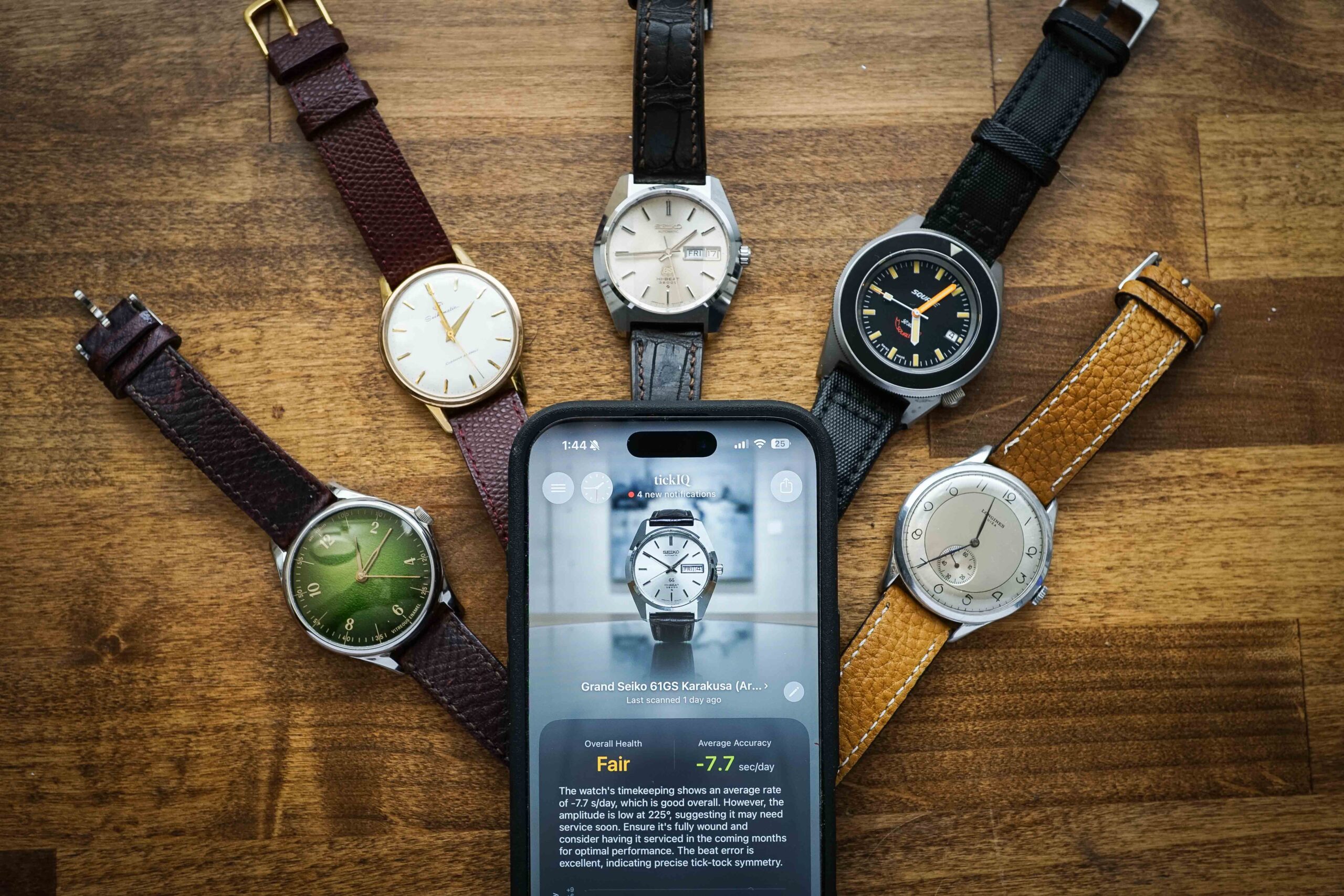
TickIQ describes itself as a companion app for watch collectors, and at the time of this article claims to have around 40,000 users. The app has a AI-driven collection tracker, a timegrapher-like extension for recording precision, beat error and amplitude while attempting to provide servicing advice, and a social network element. It’s available for iPhone only currently. The performance of the timegrapher feature will be covered in detail in a future article, but spoiler alert, don’t throw out your physical timegrapher anytime soon. For now we will be focussed on the collection and social media aspects.

The collection part of the app centers around taking photos of your watches and adding them to the collection database in the app. From the photo, it will do its best to discern the brand and model ‘automagically’. I threw it a curveball straightaway as I happened to be wearing my 1945 Longines ref 5581 with its rare Argentinian-market dial. As horology goes, this watch is a deep, deep cut and I was not expecting any useful recognition from the app.
I was duly impressed then, when the app recognized the watch as a ‘Vintage Longines Dress Watch’. Since this watch is virtually unknown (with only one other example I know of), I very much doubted this was pulled from a manufacturer database in the app. It felt a lot more like AI doing its thing behind the scenes decoding the brand from the dial print and deducing the genre of watch from the general design traits.
The Rise of AI in Watch Collecting
To test my theory, I pasted the same photo of the watch into ChatGPT and asked it to describe this watch from the photo. ‘Vintage Longines Dress Watch’ came the answer, so my hunch was confirmed that TickIQ was using AI in the background to drive its watch recognition. And why not… it’s a great use of AI to leverage the millions of watch photos taken over the years to drive its recognition. I asked ChatGPT what year that watch was from and it guessed sometime in the 1940s; which was spot on.
The next watch I chose to register with TickIQ was a Squale Opaco Originale sitting on my desk. TickIQ nailed that as a Squale 1521 ’50 Atmos’. A good spot given the bezel on my model is completely sterile and atypical for the 1521. I continued to snap more of my watches and TickIQ continued to impress. My AnOrdain was recognized as a Series 1 – useful – since I can never remember if it is a series 1 or 2. A left-field Ricoh Medallion was recognized as exactly that. Not only was I impressed with the accuracy and utility of this AI feature… I was starting to engage with the app in a meaningful way… I actuatlly wanted to carry on tearing through drawers and watch boxes to test it’s recognition algorithms again and again. It had hooked me.
Vintage Seikos and Grand Seikos were recognized, but the AI engine consistently missed the reference numbers. This is a little surprising to me since the Internet contains vast number of images of vintage Seikos with their reference numbers attached. Seiko collectors are, if anything, pedantic about their reference numbers. This meant some manual editing of watch names and numbers was required for many of my watches, but the app makes that straightforward and efficient. It did not curtail my emptying of watch boxes.
As each watch is photographed and recorded as part of your collection, the watch image is extracted from its background, enhanced and then recomposed into a scene chosen by the app. Photograph a gold dress watch and you may well find it rendered against the slightly blurred background of an expansive library. It does a good job of making the watches look good through its enhancement algorithm. I was particularly impressed with how it could reduce reflections that masked dial details. In practice, TickIQ all but eliminated the glare generated by my desk light.

Clearly the watch photographs are going through a beautification pipeline. Most of the time it does a really good job. As with anything AI-based, the results can be a little unexpected. Sometimes the hands of my watch would be moved to the classic 10 and 2 position and sometimes they would not. And in one case, the writing on my watch dial was re-rendered, and in classic LLM style, the predicted series of letter tokens made no sense once rendered. My Seiko Liner dial images now proclaims it a ’23 jewel dadwitch’. I’m not sure what a dadwitch is, but I can guess. The dial actually reads ’23 jewels diashock’

Another watch, a Seiko LM, was rendered with a cyclops on the crystal, even though the real watch does not have one. Also, the mirror finish case was rendered with a brushed finish where there never was one. AI slop aside, I think the app and its rendering pipeline do an excellent job at presenting one’s collection in the best light. I am no stranger to photographing watches and how much work it can be, so I appreciate the simplicity of achieving good looking photos with little effort.
The Social Media Aspect
TickIQ’s social media offering is called ‘Community’ and centers on posting daily watch shots, and as such, it feels like the early, less commercial days of Instagram. Photos posted by other TickIQ users appear in your feed. Posting a wrist shot of your own appears in everyone else’s feed and also records one day of wrist time against that watch in your collection.
The comingling of collection statistics with the social media feed is a smart play. It encourages everybody to post daily so they have accurate stats in their collection. It worked on me. I started posting everyday and spending a few minutes scrolling through the feed liking other wristshots and occassionally diving into other user’s collections that interested me.

As social media goes, the app is pretty basic right now. You can like a photo, post a comment, reply to a comment and follow users. As a consequence of the app’s wrist shots being a daily record, the images are not necessarily as crafted as Instagram and of course there can be a lot of repetition day-to-day. If I wear the same watch five days in a row, in order to record those days usage, I’m going to post five photos of the same watch into people’s feeds.
With some future development, I can see the community aspect becoming something bigger. It would be nice if I could post a shot from my photo collection rather than only from the camera. This would provide more creativity, varied content and I don’t see why the community feed should be constrained to only collection wristshots. However, at this time, I can only post from the camera, not an album. Given its subscription model, there are no ads and the only members are watch collectors, it seems such a great opportunity to kick start watch collecting social media again without algorithms and ads.
There is also no DM feature, so any conversation about a watch can only take place in public view in the feed. A way of holding private conversations between collectors is a must-have if the community side of the app is to grow. Usefully, collections can be made private and a number of users make use of this feature from what I have seen.

The user interface is a little weird in places, but you get used to it. For example, clicking on a username brings up their profile page with previous post count front and center, but tapping on this does not bring up their posts. Instead, one needs to tap on a greyed-out label (a color one associates with an unavailable feature) lower down to reveal the posts instead. Also there is a search option when navigating your own collection but it’s in a non-obvious place hiding behind a ‘hamburger’ icon which is typically reserved for a drop down navigation menu. In general the UI could do with some polish in places.
I also quickly found myself wanting to know a bit more about these wrists I was now seeing everyday. What sort of person were they attached to? Where were they from? What is the thinking behind the colllection? Why did they acquire certain pieces? So many questions! Would an optional general location and a brief bio really be too much to ask? I quickly seemed to build a anonymous-rapport with some like-minded collectors but I have no idea if they are local to me or on the other side of the world. If they were mildly local, it would be nice to arrange something outside of the digital realm.
There is a ‘grails’ feature which seems to be a way of bookmarking a particular watch you see on someone else’s wrist that you’d like to own someday. It even has a bookmark icon on the button. The app uses AI again to create a page for that watch, describing it and how it will fit into your existing collection. It’s interesting but it seems like an add-on to the main functionality. I’m not sure how useful people will find it. I played with it a bit but it did not provide much value to me. Your mileage may very of course.

Conclusions
So what do I think of TickIQ? As a collection app, I think it is a really solid option. The use of AI is innovative and adds to experience. It makes my collection look great. The gamification and socialization of what you wear each day is well done and effective. Two weeks after I installed the app just to try its timegrapher, here I am still posting wrist shots to my new-found community.
The community/social media aspect seems very promising. I cannot help feeling that this could be a solution to the Instagram burn-out that eroded the very watch collecting populous that it had created. Time will tell, but I am hopeful that the community tab will become a healthy, respectful, interesting, illuminating and thought-provoking place to hang out going forward.
Something I was not expecting was that it would re-enthuse me about my collection. The app consolidates my watches from their multitude of watch boxes and drawers and places them at my finger tip. Choosing a watch for the day now involves me quickly scrolling through my good-looking, AI-enhanced, watch collection on the app and choosing a watch I have not worn for a while. It even made me a wear a watch for several days that I had ear-marked for sale. Small , impractical gold dress watches? Hell yes from now on!
TickIQ is available from the iOS App Store, priced $39.99 for a 12-month subscription.